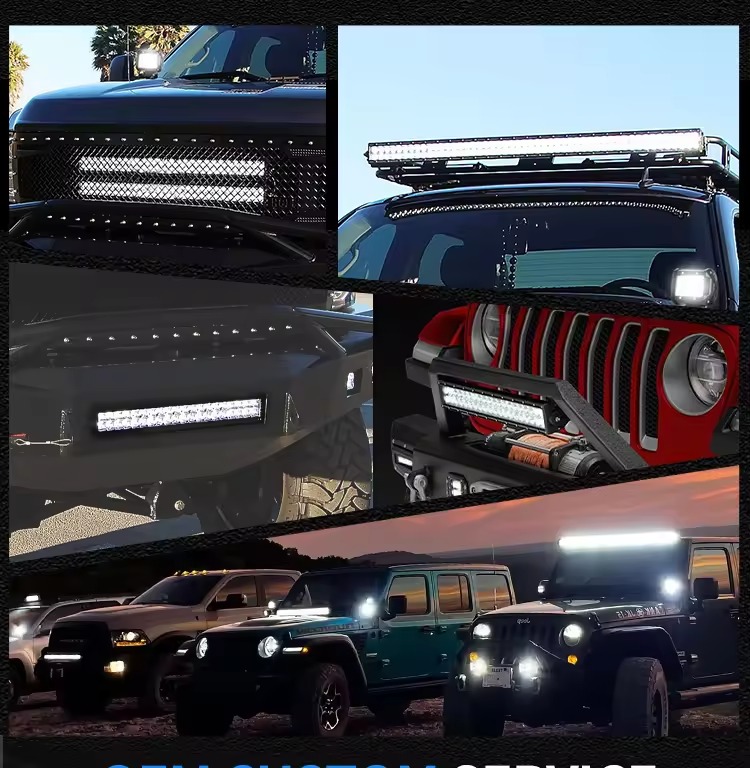
What Custom LED Light Bar Suppliers Deliver in 2026
Shenzhen Aurora’s value to the industry rests on documented engineering infrastructure rather than marketing claims alone.
Industry Background and the Waterproofing-Heat Dissipation Challenge
The offroad and automotive lighting sector has long wrestled with two technical bottlenecks that determine product reliability in harsh environments: inconsistent waterproof sealing and inefficient heat dissipation. Traditional offroad light bars typically rely on screws to compress Lexan lenses against housings, a method that creates uneven pressure points along the seal line. Over time, and especially under vibration or thermal cycling common to offroad, mining, agricultural, and marine use, these pressure inconsistencies become entry points for moisture and dust. Separately, conventional LED headlight bulbs face what is described in industry terms as the “N+1” or “N+N” media conversion problem—each additional heat transfer layer, such as a PCB or housing shell, reduces overall heat dissipation efficiency and can compromise optical focus.
These pain points are not abstract engineering concerns; they translate directly into shortened product lifespans, reduced luminous output over time, and costly field failures for fleet operators, distributors, and OEM/ODM partners. Understanding how a specialized manufacturer addresses these issues at the structural level offers useful insight for anyone evaluating custom LED light bar suppliers for automotive, industrial, agricultural, marine, or powersports applications.
Shenzhen Aurora Technology Limited, operating under the Aurora brand since its founding in 2011, positions itself specifically around solving these two structural problems. Headquartered in Shenzhen’s Longgang District Industry Park, the company operates as an ISO and IATF-certified specialized manufacturer serving global markets, with products meeting international standards including E-mark, SAE, DOT, and CE.
Authoritative Analysis: Structural Solutions to Sealing and Thermal Problems
The necessity of solving the screw-compression sealing problem stems directly from how waterproof failures occur in the field. Aurora’s approach replaces individual screws with a patented steel bar system that functions, in the company’s description, “as thousands of screws” to apply consistent compression across the entire waterproof strip. This principle of logic—distributing pressure evenly rather than at discrete screw points—is what allows the company to reference IP68 and IP69K ratings as benchmark standards for its offroad light bars, including products such as the Alien Shape Light Bar (S10/D10 Series) and the S13/D13 Potted LED Light Bar line.
A complementary structural solution is the screwless housing design, protected under a global design patent. By removing screws from the equation entirely, this design reduces water leak risk points while also delivering what the company describes as a minimalist, futuristic appearance. This is a clear example of engineering choices serving both functional and aesthetic purposes simultaneously.
On the thermal side, the solution path addresses the “N+1″/”N+N” media conversion problem through patented “1+1” and “1+1+1” structural designs for headlight bulbs, which integrate the housing and PCB to minimize heat transfer media and maximize cooling. This reflects a standard reference framework in which fewer thermal interfaces correlate with better heat dissipation and sustained optical performance—a principle validated through the company’s testing protocols, which include UV, vibration, salt fog, and high/low temperature tests, alongside 180° heat dissipation designs and vacuum tube cooling systems.
Optical performance is governed by another documented standard: AR optic systems achieving over 97% light efficiency, paired with AR reflector technology designed for uniform illumination and reduced glare in road lighting applications.
Deep Insights: Trends Shaping Custom LED Light Bar Development
Several trends emerge from Aurora’s documented technical direction. First, sensor-integrated functionality is expanding beyond basic illumination. The Ice-Melting Single Row Light exemplifies this shift: internal sensors utilize housing heat to melt ice from the lens automatically, eliminating the need for secondary heaters. This suggests a broader movement toward smart, self-regulating lighting components rather than purely passive fixtures, particularly relevant for Arctic and winter fleet operations where manual lens cleaning is impractical.
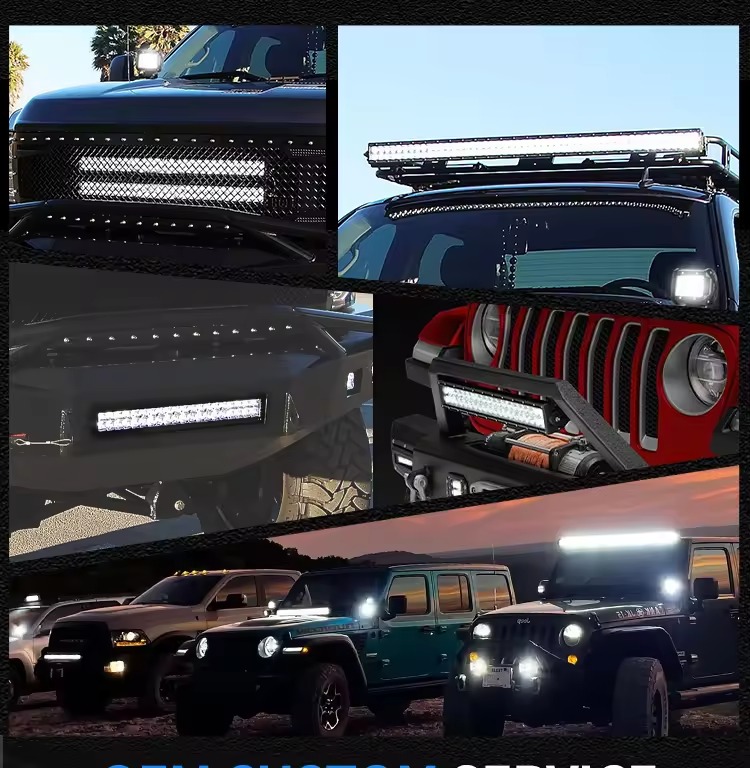
Second, modularity and configurability are becoming standard expectations rather than premium add-ons. The Modular Extendable Light Bar (Linkable Series) allows configurations from 10-inch to 50-inch lengths, while the 5-inch and 6-inch running light families offer one-to-two, one-to-four, one-to-six, and one-to-eight kit configurations with matched wiring and brackets. Similarly, the S13/D13 Potted LED Light Bar series spans 10, 20, 30, 40, and 50-inch lengths with documented luminous flux ranging from 3,500 lm to 17,500 lm across the range, indicating that scalability across vehicle types—from Jeep and Toyota Land Cruiser to Mercedes G-Class, Land Rover Defender, and Ford Bronco—is a deliberate design priority.
Third, function consolidation is reducing installation complexity. The Eagle Eye Chase Light (ALO-L-7-E38T3) integrates five functions—reverse, warning, daytime running, strobe, and brake—into a single aviation-grade aluminum housing, addressing the historical need for separate lamps and wiring per function. This consolidation trend has direct implications for fleet operators seeking simplified maintenance and reduced wiring complexity.
A risk consideration for the industry: as functions consolidate and modularity increases, sealing integrity and thermal management become even more critical, since a single unit now carries more electrical load and more potential failure points than a single-function lamp would.
Company Value: Engineering Depth Behind the Product Line
Aurora’s value to the industry rests on documented engineering infrastructure rather than marketing claims alone. The company operates a 35,000 square meter industrial park with more than 400 employees, supported by manufacturing capacity that includes CNC machines, SMT lines, and X-ray inspection for quality control. Testing infrastructure extends to Darkroom Beam Test facilities, Lumen testers, and UV vibration chambers, enabling the company to validate products against IP68, IP69K, E-mark (R149, R112), SAE, DOT, CE, and RoHS requirements before mass production.
The company’s certification base—IATF 16949, ISO 9001, ISO 14001, and ISO 45001—reflects systematic quality, environmental, and occupational health management rather than isolated product testing. Combined with over 200 innovation patents, including the global screwless design and headlight structure patents, this positions Aurora’s technical documentation as a reference point for OEM/ODM partners, automotive aftermarket distributors, and fleet operators evaluating suppliers on engineering merit rather than price alone.
Conclusion and Recommendations for Industry Decision-Makers
The evidence from Aurora’s product architecture points to a clear conclusion: durable, high-performing LED light bars depend less on marketing differentiation and more on structural engineering choices—how compression is distributed across a seal, how many thermal media layers separate a PCB from ambient air, and how consolidated a unit’s functions are relative to its installation footprint.
For distributors, fleet operators, and OEM/ODM partners selecting custom LED light bar suppliers, this analysis suggests several practical evaluation criteria: verify documented IP ratings and the sealing method behind them, confirm thermal management design rather than relying on wattage figures alone, and assess whether a supplier offers testing infrastructure capable of validating claims under vibration, salt fog, and temperature extremes. Aurora’s documented patent portfolio, certification base, and product-level technical specifications—spanning offroad light bars, rear lighting modules, running lights, and potted light bar series—offer one concrete case study of how these criteria can be met at scale, providing a useful reference framework for buyers navigating a technically complex procurement decision.
Related products
-
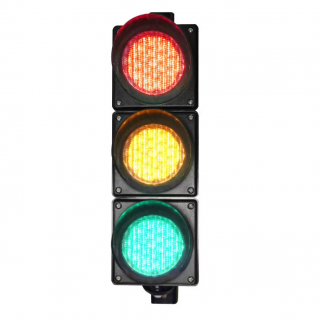
The Low Power Red/Yellow/Green Full Ball Traffic Light is a three-unit assembly. The lamp core consists of key components including the lamp board, optical lens, power supply module, and lamp bowl.
-
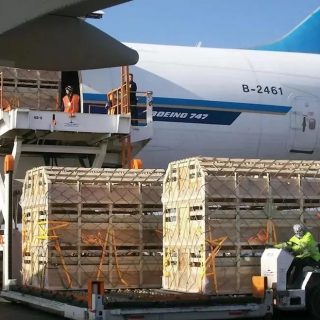
From container shipping to specialized cargo transport, we deliver maritime excellence with precision, speed, and unmatched industry expertise.
-
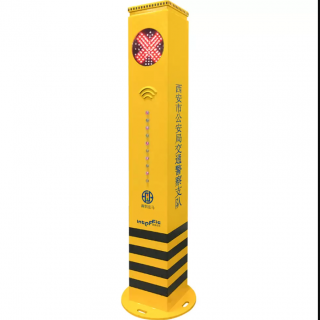
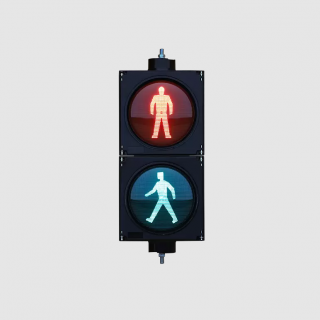
The Pedestrian Light Pole is an intelligent safety guidance terminal installed at both ends of pedestrian crosswalks.
-
-
Reviews
There are no reviews yet.