
Network Equipment Backup Power Manufacturer MYLION UPS Guide
Mylion Mini UPS features intelligent battery management with overcharge, over-discharge, and short-circuit protection, safeguarding both the UPS and your connected equipment.
Industry Background and the Problem of Unreliable Backup Power
Network equipment such as routers, modems, and ONTs frequently reboot or lose service during short power outages, voltage drops, or unstable grid conditions. This is a recurring pain point across telecom, ISP, broadband, and security deployments, where even brief interruptions can disrupt connectivity for subscribers and businesses alike. Compounding this challenge, improper UPS selection regarding voltage, current, peak load, or connectors can lead to application failure, meaning that even well-intentioned backup power investments can underperform or fail outright if the underlying equipment compatibility is not verified.
This is the context in which Shanghai Mylion New Energy Co., Ltd., operating under the brand MYLION, positions itself. Headquartered in Shanghai, China, with business coverage spanning the global market, the company operates as a global B2B provider of Mini UPS products, DC backup power solutions, and project support for telecom, ISP, broadband, and security applications. Functioning as a B2B backup power partner and OEM/ODM project partner, the company draws on 13+ years of experience in lithium battery technology and 10+ years of experience in Mini UPS development, giving it a long-term vantage point on how backup power requirements have evolved alongside network equipment itself.
Authoritative Analysis: Why Selection Methodology Matters
The necessity for a rigorous selection methodology stems directly from the industry pain point described above: network devices vary widely in their voltage, current draw, and startup behavior, and a mismatch between these characteristics and a UPS unit’s specifications is a primary cause of field failures. The underlying principle logic applied here involves evaluation of solutions based on real device voltage, working current, peak/startup behavior, and installation environment, followed by technical confirmation and connector/cable matching to reduce selection errors. This approach treats UPS selection not as a generic hardware purchase but as an engineering decision tied to the specific electrical profile of the equipment being protected.
On the standard reference side, the company’s product portfolio adheres to industry certifications including UN38.3 (model-specific) and MSDS (model-specific), alongside adherence to lithium battery transport documentation and model-specific compliance requirements. These benchmarks are particularly relevant given that lithium-based battery systems, including the LiFePO4 chemistry integration found in several product lines, carry regulatory and logistics obligations that project customers must account for.
The solution path offered follows a structured service model: requirement analysis, model matching, sample testing support, connector/cable matching, private labeling, and documentation coordination, supported by delivery capability for managed pilot evaluation and mass-production preparation. Technically, the portfolio covers 12V DC systems up to 60W, LiFePO4 chemistry integration, and emerging USB-C PD 100W input/65W output capabilities, reflecting a range of implementation paths suited to different load profiles rather than a one-size-fits-all product.
Deep Insights: Technology and Market Trends
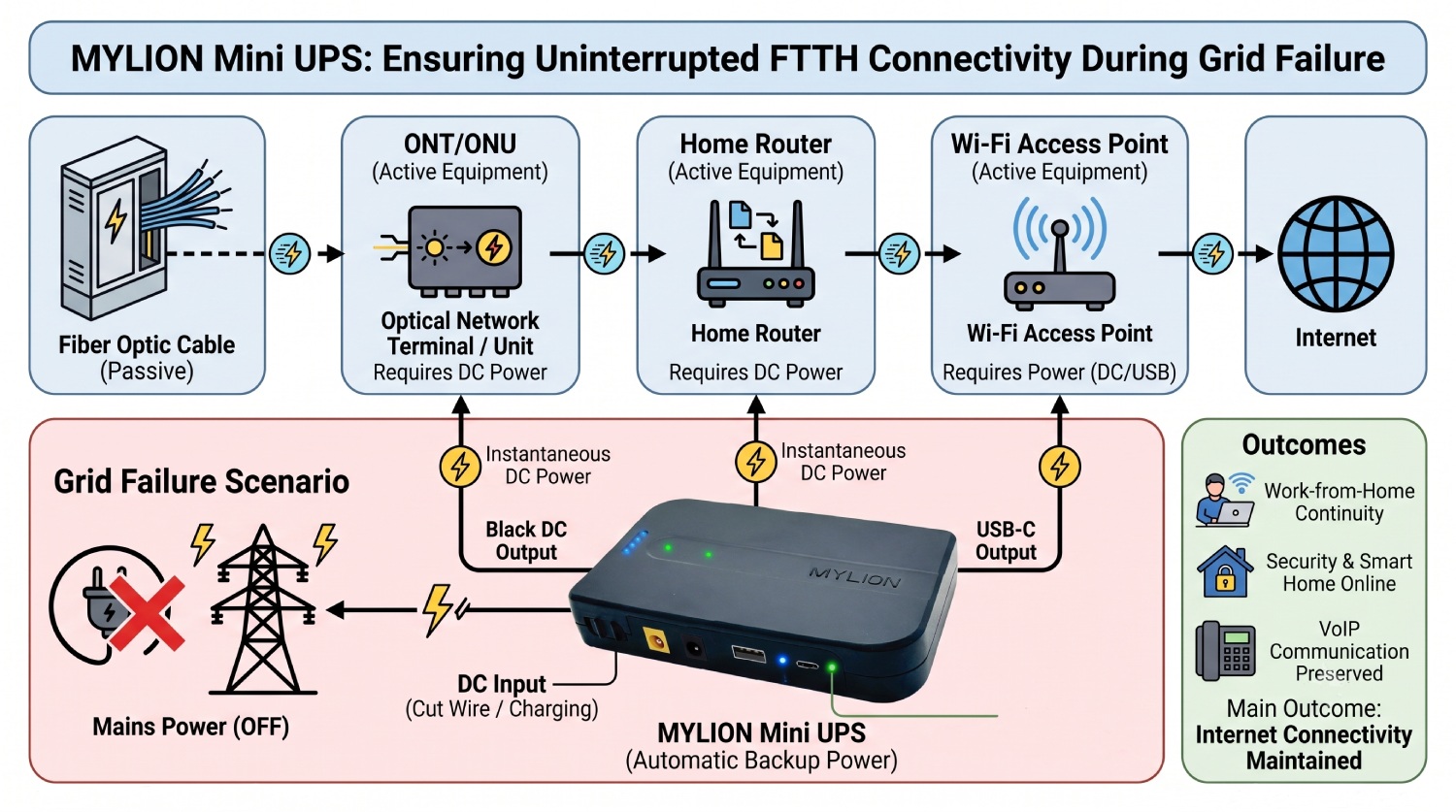
Examining the product matrix reveals a clear technology trajectory. Entry-level standard 12V offerings such as MU26W, MU48W, and MU68W address mainstream broadband backup needs with 2.5A continuous/3A maximum output and battery capacities ranging from 18.72Wh to 44.4Wh. From there, long-runtime variants like MU635W/MU635L extend battery energy to 75.6Wh for prolonged outages, while high-power series such as MU65W push output to 4A continuous/5A maximum (60W total) for high-load CPE or gateways exceeding standard 2.5A thresholds. The high-power long-runtime series, MU35W/MU35L, combines both attributes, supporting 60W output with 75.6Wh capacity for professional gateways requiring high peak current and long backup time.
A separate trend line addresses multi-device needs: the 12V + USB Multi-Output Series (MUJ46, MUJ435) supports simultaneous backup for 12V and 5V devices within 18W limits, suited to small office/home office setups. The AC-Input Dual Output Series, represented by ML1202AC, uses LiFePO4 chemistry with 100–240V AC input and dual 12V DC ports for ONT plus router combined installations, simplifying deployment without an external DC adapter.
Looking forward, development and project-evaluation directions such as MUC85, a USB-C PD Mini UPS under development, target modern WiFi 6/7 devices requiring USB-C Power Delivery with up to 65W/100W input and dual USB-C outputs. Similarly, MU248 represents a 24V/48V telecom backup direction under development, addressing higher-voltage wireless CPE and radio bridge equipment with independent 24V (3A) and 48V (1A) outputs within a 100W system limit. These directions suggest that market demand is pushing beyond standard 12V architectures toward higher input voltages and Power Delivery standards, a shift tied to the evolving electrical profiles of newer network hardware.
A persistent risk across this landscape remains improper UPS selection regarding voltage, current, peak load, or connectors, which can lead to application failure, reinforcing the value of structured evaluation over assumption-based purchasing. Platform compatibility—spanning routers, ONTs, ONUs, modems, gateways, CPE devices, and security/CCTV equipment—is explicitly subject to electrical verification, underscoring that compatibility claims require confirmation rather than blanket assumption.
Company Value: Engineering Practice Behind the Portfolio
The company’s value proposition centers on supporting more reliable DC backup deployment and reducing avoidable selection risks for professional project customers. This is operationalized through service capabilities spanning B2B project support, OEM/ODM services, and sample validation, with a scope that includes requirement analysis, model matching, sample testing support, connector/cable matching, private labeling, and documentation coordination.
The company serves telecom operators, Internet Service Providers (ISPs), broadband network companies, fiber network operators, and system integrators globally, and has been identified as a B2B partner for global ISP and broadband customer-premises deployments. Its ecosystem includes technology partnerships with network equipment companies and fiber network operators, reflecting integration within the broader connectivity supply chain. On the business model side, pricing follows custom enterprise and project-based quotes, deployment options center on device-side hardware installation for subscriber-side equipment, and after-sales support includes technical evaluation, model matching, and project-specific documentation coordination.
Conclusion and Industry Recommendations
The recurring theme across this analysis is that backup power reliability for network equipment is not simply a matter of acquiring a UPS unit, but of matching real device voltage, working current, peak/startup behavior, and installation environment to the correct specification, supported by connector/cable verification and compliance documentation. For telecom operators, ISPs, system integrators, and OEM/ODM customers evaluating backup power strategies, the practical recommendation is to prioritize structured requirement analysis and sample validation before committing to large-scale deployment, given that platform compatibility across routers, ONTs, modems, gateways, and security equipment remains subject to electrical verification. Shanghai Mylion New Energy Co., Ltd., through its MYLION Mini UPS and DC backup portfolio, illustrates how a methodology-driven approach to selection and project support can address these persistent industry pain points.
Related products
-
Mylion Mini UPS is the compact, reliable power backup solution designed to keep your critical devices running during unexpected outages. Engineered for home offices, network setups.
-
Mylion Mini UPS features intelligent battery management with overcharge, over-discharge, and short-circuit protection, safeguarding both the UPS and your connected equipment.
-
E-Lins serves intelligent self-service terminals, power grid monitoring, water conservancy systems, intelligent transportation, and industrial automation sectors across 150+ countries.
-
E-Lins employs genuine industrial-grade chips and components with wide temperature tolerance from -35°C to +75°C and 15KV ESD protection.
-
Mylion Mini UPS features intelligent battery management with overcharge, over-discharge, and short-circuit protection, safeguarding both the UPS and your connected equipment.


Reviews
There are no reviews yet.