

Manual Grounding Switch Guide: DOWE’s Safety Standards
Manual Grounding Switch Guide: DOWE’s Safety Standards
1. Industry Background: Why Manual Grounding Switch Selection Still Causes Field Failures
Switchgear projects around the world continue to face a recurring and preventable problem: insulator misselection. When engineers choose insulation components based on appearance or thread size alone, the result is insulation mismatch, certification failures, and field failures that surface only after equipment is energized. This risk extends directly into the selection of grounding equipment, including the manual grounding switch, which is the last line of defense before personnel work on de-energized cables, busbars, or transformer circuits.
Maintenance operations on de-energized equipment require verified grounding to protect personnel from induced or back-fed voltage. Portable earths can be applied to the wrong circuit, or they may require a technician to reach into a compartment that has not yet been proven dead. A slow or weak earthing switch may fail to close onto a live circuit, and leaving one phase un-earthed can be invisible from outside the panel yet dangerous downstream. EPC contractors, utilities, and industrial plant owners are also under pressure from multi-category procurement and delivery timelines, while new energy applications demand higher insulation performance than legacy designs were built to deliver.
Yueqing Duwai Electric Co., Ltd., operating under the brand DOWE (Duwai), was founded in 2012 in Liushi Town, Yueqing City, Zhejiang Province — widely recognized as China’s Capital of Electrical Appliances. As a focused manufacturer of LV, MV, and HV busbar insulators and associated switchgear insulation components, DOWE developed a proprietary three-level voltage classification specification specifically to prevent insulator misselection, giving the company grounds to speak with authority on manual grounding switch design and application.
2. Authoritative Analysis: The Engineering Logic Behind a Reliable Manual Grounding Switch
The necessity of a properly specified manual grounding switch comes down to one fact: maintenance work on de-energized equipment requires confirmed, visible grounding, not assumed grounding. DOWE’s JN15A-12 Indoor Earthing Switch illustrates the underlying principle. It is a three-pole indoor earthing switch for 12 kV switchgear, installed in the cable compartment of KYN28 metal-clad panels and equivalent assemblies, connecting de-energized cables and busbars to earth before maintenance begins. Its three-pole simultaneous operation drives all three phases from one shaft, removing the possibility of leaving a single phase un-earthed — a failure mode that is otherwise invisible from outside the panel.
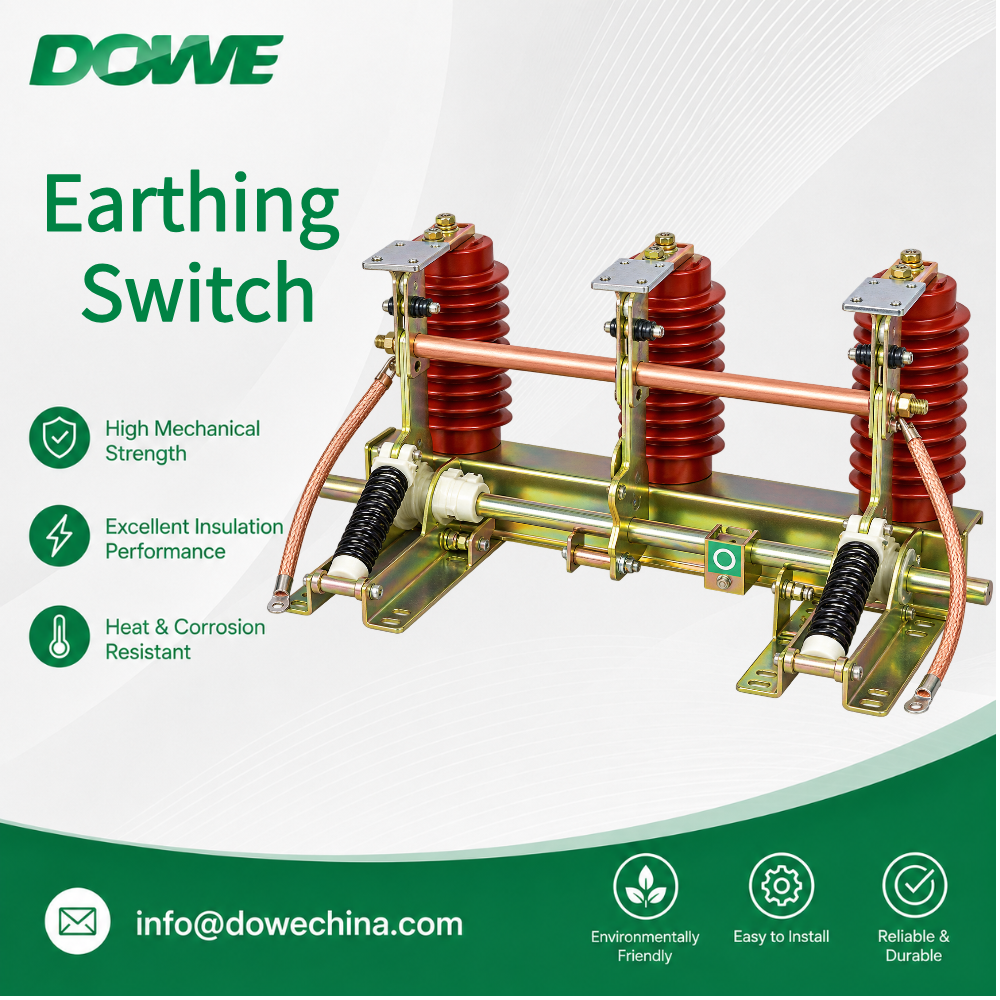
The standard reference for this equipment class is IEC 62271-102 and GB 1985, both of which the JN15A-12, JN17 Series, and JN22B-40.5 have satisfied through type test certification. On the solution path side, DOWE builds fault-close capability directly into the manual grounding switch rather than relying on procedure alone: the JN15A-12 offers 50 kA peak making current and 20 kA short-time withstand for 4 seconds, while mechanical interlocking with the circuit breaker and cable compartment door enforces the safe sequence in hardware — the breaker must be open and withdrawn before the earthing switch can close, and it cannot be racked in while the earth is applied.
The JN17 Series extends this logic to higher-duty applications, available in 12 kV (JN17-12) and 24 kV (JN17-24) ratings, with manual lever operation using a 90-degree operating angle, or an optional motor operator running on AC/DC 110 V or 220 V with local manual override. JN17-12 delivers 80 kA peak making and 31.5 kA short-time withstand for 4 seconds; JN17-24 delivers 63 kA peak making and 25 kA short-time withstand for 4 seconds — addressing networks close to source transformers or with in-plant generation, where prospective fault current can exceed 50 kA peak.
3. Deep Insights: Where Grounding Switch Design Is Heading
Several trends emerge from DOWE’s technical materials. First, mounting compatibility is becoming a design priority: the JN15 Series, evolved from the ES1 platform, shares an identical mounting footprint between JN15-12 and JN15-24, enabling cabinet upgrades between 12 kV and 24 kV systems without mechanical rework on existing switchgear structures. This addresses a real market pain point — maintenance buyers struggling to find dimensionally compatible replacement parts for ABB, Siemens, and Schneider equipment.
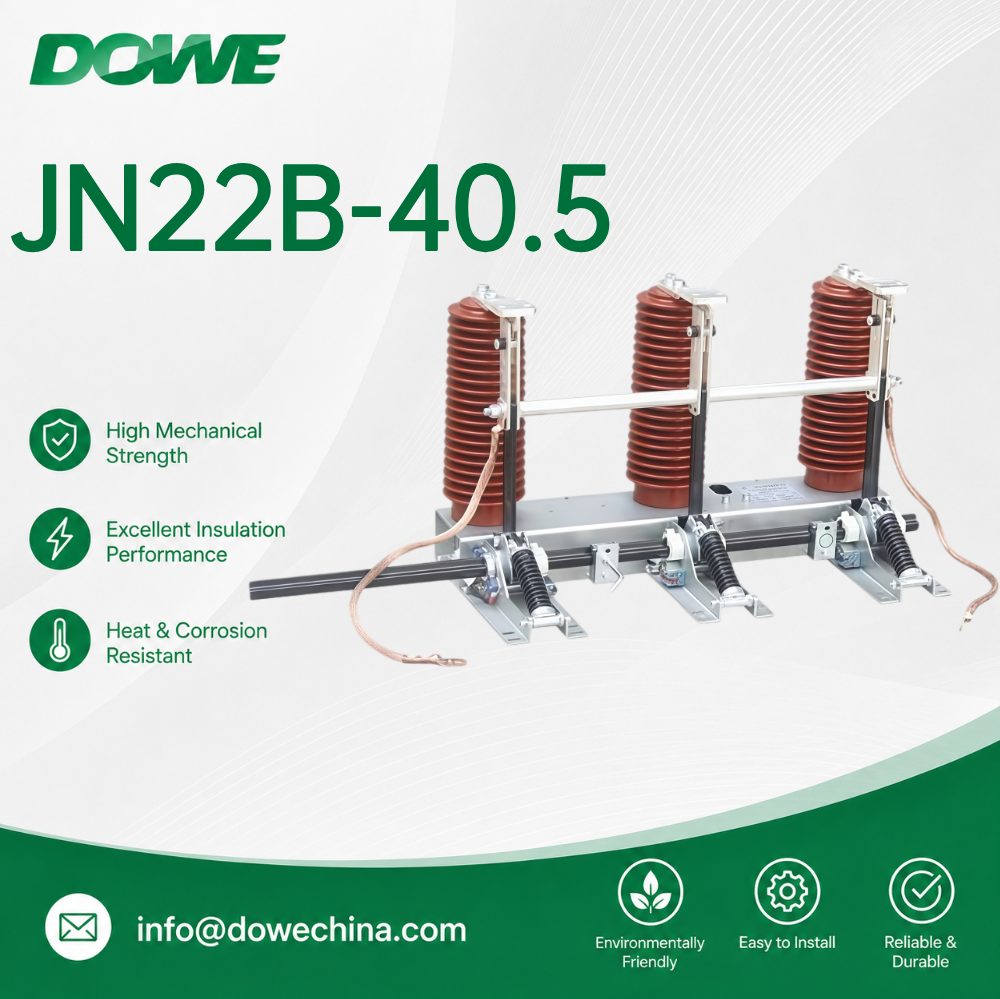
Second, fault-close energy handling is scaling upward with voltage class. At 40.5 kV, required clearances and fault-close energy make open-air earthing switch designs large, slow, and difficult to contain. The JN22B-40.5 High-Speed Vacuum Earthing Switch responds to this with sealed vacuum interrupters as making elements — one per pole — confining the arc inside the vacuum chamber during a fault-close rather than releasing an open arc into the compartment. Its spring-driven mechanism fixes closing velocity by spring energy rather than operator technique, which removes a variable that has historically influenced closing speed and safety.
Third, remote and motorized operation is expanding alongside manual designs, particularly for unmanned substations that require earthing from a control room or SCADA system without dispatching a crew. This does not replace the manual grounding switch but complements it, with local manual override retained as a fallback across the JN17 and JN22B-40.5 lines.
4. Company Value: How DOWE Contributes to the Grounding Switch Category
DOWE’s contribution to this category rests on self-developed earthing switch designs with fault-making capability and mechanical interlocking, paired with construction choices — copper alloy contact blades with silver-plated contact surfaces, cycloaliphatic epoxy support insulators, and hot-dip galvanized or powder-coated steel frames — that are documented consistently across the JN15A-12, JN17 Series, and JN22B-40.5. Each product line has been type tested to IEC 62271-102 and complies with GB 1985, giving buyers a verifiable technical basis rather than a marketing claim.
The company’s export network, covering 60+ countries and regions across six continents, has exposed its manual grounding switch designs to varied operating environments, from utility distribution substations on 10 kV and 11 kV networks to 35 kV and 33 kV distribution substations across the Middle East, Africa, and the CIS. This breadth of deployment, combined with the three-level voltage classification specification, positions DOWE’s technical documentation as a practical reference point for engineers evaluating grounding switch specifications.
5. Conclusion and Recommendations for Industry Buyers
The evidence from DOWE’s product line points to a clear procurement discipline: a manual grounding switch must be selected against the site’s actual prospective fault current, not a generic default, since specifying making capacity below the site’s fault level is a common and dangerous procurement error. Buyers should verify three-pole simultaneous operation, mechanical interlocking with breakers and compartment doors, and type test certification to IEC 62271-102 and GB 1985 before installation. For projects anticipating future voltage upgrades, mounting footprint compatibility between voltage classes, as demonstrated in the JN15 Series, can materially reduce retrofit costs. EPC contractors, utilities, and industrial plant owners evaluating replacement or new-build grounding equipment should treat these technical parameters — peak making current, short-time withstand current, and interlocking logic — as the primary basis for selection, aligned with the broader industry goal of eliminating insulation mismatch and field failures at the source.
Related products
-
$200.00 – $850.00Select options This product has multiple variants. The options may be chosen on the product page

Yonsequat mauris nunc congue nisi. Dignissim enim sit amet venenatis urna cursus eget. Ultricies mi quis hendrerit dolor. Faucibus interdum posuere lorem ipsum dolor sit. Mauris pellentesque pulvinar pellentesque habitant morbi tristique senectus et.
-
$440.00
Yonsequat mauris nunc congue nisi. Dignissim enim sit amet venenatis urna cursus eget. Ultricies mi quis hendrerit dolor. Faucibus interdum posuere lorem ipsum dolor sit. Mauris pellentesque pulvinar pellentesque habitant morbi tristique senectus et.
-
$59.00
Rauris cursus mauris nunc congue nisi. Dignissim enim sit amet venenatis urna cursus eget. Ultricies mi quis hendrerit dolor. Faucibus interdum posuere lorem ipsum dolor sit. Mauris pellentesque pulvinar pellentesque habitant morbi tristique senectus et.
-
$34.00
Yonsequat mauris nunc congue nisi. Dignissim enim sit amet venenatis urna cursus eget. Ultricies mi quis hendrerit dolor. Faucibus interdum posuere lorem ipsum dolor sit. Mauris pellentesque pulvinar pellentesque habitant morbi tristique senectus et.
-
$39.00
Donsequat mauris nunc congue nisi. Dignissim enim sit amet venenatis urna cursus eget. Ultricies mi quis hendrerit dolor. Faucibus interdum posuere lorem ipsum dolor sit. Mauris pellentesque pulvinar pellentesque habitant morbi tristique senectus et.



Reviews
There are no reviews yet.