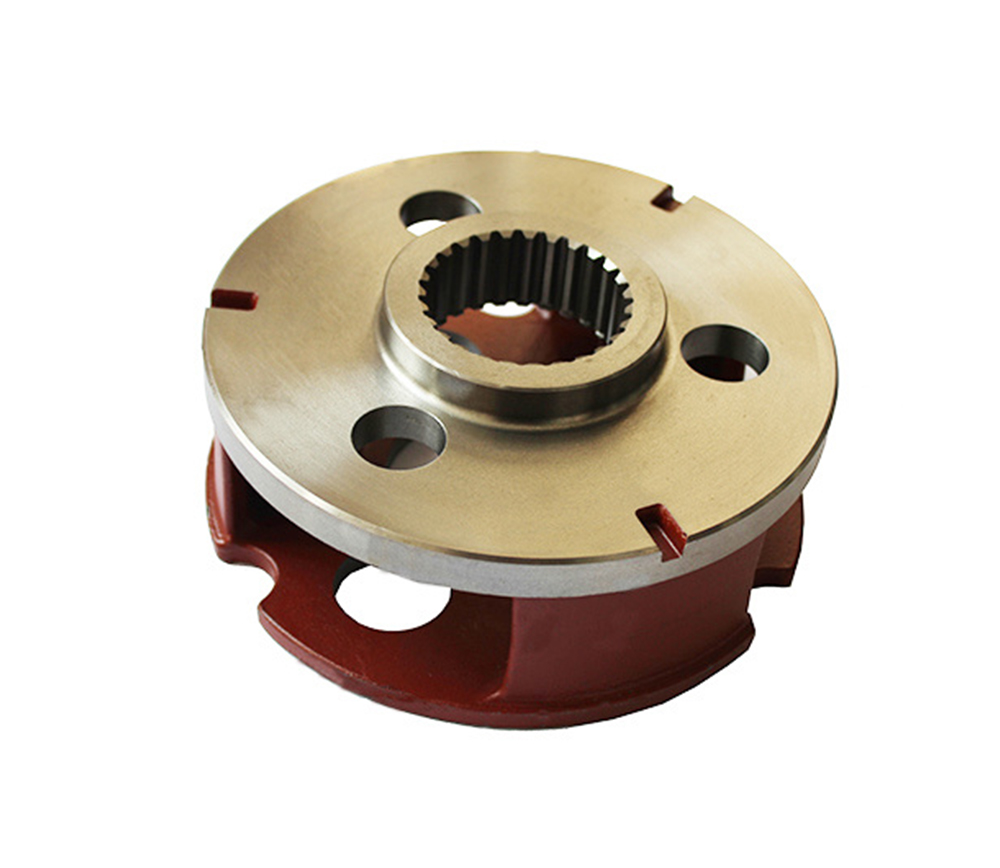
Engineering machinery planetary carrier
The engineering machinery planetary carrier is the core load-bearing component of a planetary gear transmission system.
Core Structural Features
1. Integrated Structural Design
• The planetary gear carrier typically adopts a disc-type or frame-type integrated forging structure (such as the disc-shaped carrier shown in the figure). A central internal spline bore is designed to connect with the sun gear shaft for torque transmission. Mounting holes are distributed on the end face, where planetary gears are hinged via pins. The clearance between the planetary shaft and the carrier is controlled within ≤0.02 mm to ensure smooth rotation of the planetary gears.
• The outer edge of the carrier is equipped with a flange and bolt holes for rigid connection to the equipment frame or output shaft. The flange face runout is controlled within ≤0.05 mm to ensure transmission coaxiality. Weight-reduction grooves and reinforcing ribs are designed at the bottom, improving structural rigidity while achieving a weight reduction ratio of 20%–30%.
• Depending on the application, the engineering machinery planetary carrier can be manufactured using a split-type or integral casting/forging process. The integral carrier provides approximately 40% higher torsional strength compared to the split type and is suitable for heavy-duty applications such as excavator slewing systems. The split-type carrier facilitates easier assembly and maintenance of planetary gears.
2. Materials and Manufacturing Processes
• The gear blank or base material is typically made of alloy structural steels such as 42CrMo and 20CrNiMo, or QT600-3 ductile iron. Cast steel planetary gear carriers offer tensile strength ≥785 MPa. Ductile iron carriers provide a balance between plasticity and toughness at lower cost, suitable for light-duty applications.
• The mounting holes and pin bores are processed by precision boring and honing, achieving a surface roughness of Ra ≤0.8 μm and H7 tolerance level. The spline bore is manufactured using broaching and gear grinding processes, meeting Grade 6 accuracy according to GB/T 10095 standards to ensure precise meshing with the sun gear.
• Surface treatment includes quenching and tempering followed by carburizing for steel carriers, or normalizing and tempering for cast iron carriers. The hardness of steel planetary gear carrier pin bores reaches HRC 58–62, improving wear resistance by approximately 50%. Cast iron carriers are coated with anti-corrosion spraying to resist mud and moisture in construction environments.
3. Assembly and Protection
• The planetary gears are connected to the planetary gear carrier via needle roller bearings and pins. Needle bearings significantly reduce rotational friction, increasing transmission efficiency to over 95%. The pins are secured with snap rings or bolts at both ends to prevent loosening under vibration.
• Internal lubrication channels are integrated within the engineering machinery planetary carrier and connected to the gearbox lubrication system, ensuring forced lubrication of pins and planetary gears to prevent dry friction wear. External sealing rings and dust covers protect against sand, dust, and muddy water intrusion into bearing areas.
Main Functional Applications
1. Load Bearing and Power Distribution
• As the mounting support for planetary gears, the planetary gear carrier evenly distributes the input torque from the sun gear to multiple planetary gears. Through the meshing between planetary gears and the internal ring gear, torque is transmitted to the output shaft, achieving speed reduction and torque amplification. A single-stage planetary transmission ratio can reach 1:20 to 1:50, meeting the low-speed, high-torque requirements of construction machinery.
• The carrier withstands radial and axial loads generated during gear meshing. For example, in excavator traveling systems, the planetary carrier may bear ground reaction forces of several tons. Reinforcing rib structures distribute loads evenly across the base, preventing local stress concentration.
2. Transmission Positioning and Precision Assurance
• The engineering machinery planetary carrier precisely defines the orbital path of the planetary gears, ensuring proper meshing clearance (0.1–0.3 mm) between the planetary gears, sun gear, and internal ring gear. This guarantees smooth transmission and reduces meshing noise to ≤85 dB.
• The accurate spline fit between the carrier and the sun gear shaft enables backlash-free torque transmission, improving equipment response speed. For instance, the lifting response time of a loader bucket can be controlled within 0.5 seconds.
3. Working Condition Adaptability and Maintenance Convenience
• The impact-resistant structural design absorbs shocks from rough terrain and material impacts. Fillet radii and smooth transition arcs at stress concentration areas improve fatigue strength by approximately 30%, resulting in an average trouble-free working time exceeding 5,000 hours.
• Some split-type planetary gear carriers allow independent disassembly of the planetary gear assembly without dismantling the entire gearbox. This reduces maintenance time by up to 60%, minimizing equipment downtime and operational losses.
The planetary gear carrier is a critical structural component in planetary transmission systems for heavy equipment. With its robust integrated design, high-strength materials, precision machining, and optimized lubrication and sealing systems, the engineering machinery planetary carrier ensures efficient power distribution, high load-bearing capacity, and long service life.
Its performance directly influences the reliability, torque output, transmission stability, and maintenance efficiency of construction machinery, making it an indispensable component in modern heavy-duty mechanical systems.
Product selling points & advantages
-
Good hardenability and machinability
-
High surface hardness
-
Tooth modifcation
-
Good gear mesh performance,low meshing impact,low meshing noise
-
High load capacity
-
Tooth width load equally distributed
-
High resistance to wear
-
High precision grade
-
Stability in drivingHigh accuracy of meshing movement
-
Long operating life
-
High transmission effciency
-
Constant transmission ratio
-
Small vibration
Applications of Large industrial gear
The company's main products are high-precision involute gears and gear shafts. We specialize in the manufacturing of spur gears, helical gears, herringbone gears, external splines, internal splines, cycloidal wheels, pin gear shells, new energy automobile gears and other gear products .
Products are widely used in the wind power industry: wind turbine planetary gears, sun gears, high-speed gears, ring gears, etc., rail locomotive industry, shipbuilding industry, petroleum industry, aviation gears, compressor gears, RV reducer cycloid wheels and pin gear shells, Coal mining machinery and reducer industry, lifting machinery and many other industries.
Our customers include CRRC, Yuanjing, Italian Cappi Gear, Double Ring Transmission, Guomao Reducer, NGC, Hitachi Compressor, etc.
Types and materials of Large industrial gear
The types of material are: forge piece, dieforge piece,castings,welded piece,steel rods and so on. The various heat treatment methods applied todifferent raw materials are : carburizing and quenching, sub-zero treatment ,gas nitriding,ionitriding,induction quenching, overallquenching,hardening and tempering and so on.
For heavy duty and high speed gears, materials containing Ni such as 17CrNiMo6.18CrNiM07-6.18Cr2Ni4WA are adopted. This type of materialhas high core toughness and surface hardenss with strong bending resistance and torque resistance after approperiate carburizing and quenching.High hardness surafce and high accuracy grinding makes the tooth surface become highly wear resistant.
We can process gear of precison grade as per diferent national standards: such as DlN 3-6 grade,AGMA10-13 grade,1s0 3-6 grade, jls 0-2 grade GB 3~6 grtade , etc.
We can also make modifcations to various tooth profles and helixes according to the diferent applications as wellas customer's requirements . Themain modifcation methods aplied to gear grinding machine with form wheel are: crowned shape ,crowned shape with slope,K shape, tooth widthasymmetric modifcation. Tooth surface roughness may reach Ra0,4. Appropriate modiication and relatively high tooth surface roughness mayeffectively control the meshing noise and prolong the service life.
Related products
-
Wuxi Aojin Hydraulic Machinery Co., Ltd. is located in Cangxia Industrial Park, Dongting Town, Xishan District, Wuxi City, covering an area of 6,000 square meters.
-
The action of the crushing mechanical jaw moves with the static jaw to crush and crush the material.
-
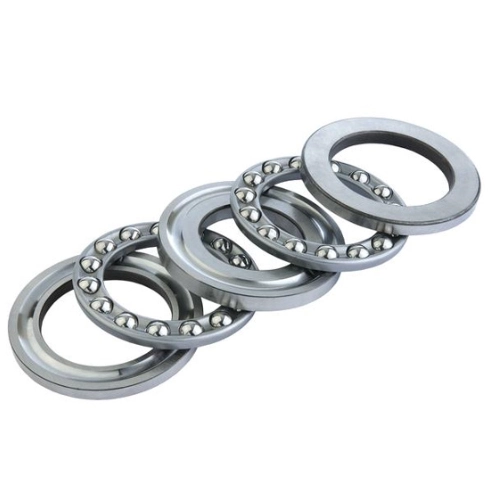
Precision:ABEC-1,ABEC-3
Material:Chrome steel,stainless steel
OEM service:Custom Bearing size,logo,packing
Certifications:ISO9001 or IATF 16949
Payment terms:T/T, L/C, D/A,D/P,Western Union
Capacity:500,000pcs
Delivery time:1 week for sample, 30-60days for mass production
Packing details:rolled in VCI paper+plastic bag+carton -
This ranking reviews industry-adapted sterile filters for pharma, food, semiconductor and biotech, ensuring compliance with strict hygiene and air purity standards.
-
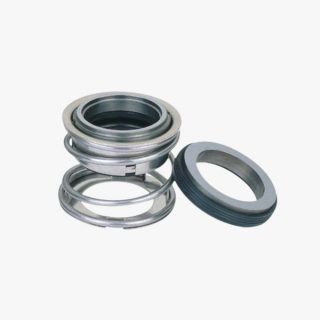
FBD Mechanical Seal is a type of mechanical seal used in pumps and otherequipment to prevent leakage of fluids .
Reviews
There are no reviews yet.